
Storyboard Furniture Ltd. brings furniture from “Tree to Table.” The studio salvages ill-fated trees from clients’ properties to create singularly beautiful, ecologically responsible custom furniture.
The team approaches this work both as makers and artists. While they seek perfection in function and form, they also look at every project through a different lens – one of storytelling and meaning-making. Beginning with the material beauty of the wood unveiled by milling a tree, the stories that tree has witnessed in its life are drawn out through intelligent design and exacting craftsmanship. Imagine sitting in a chair made from the tree you climbed as a child.
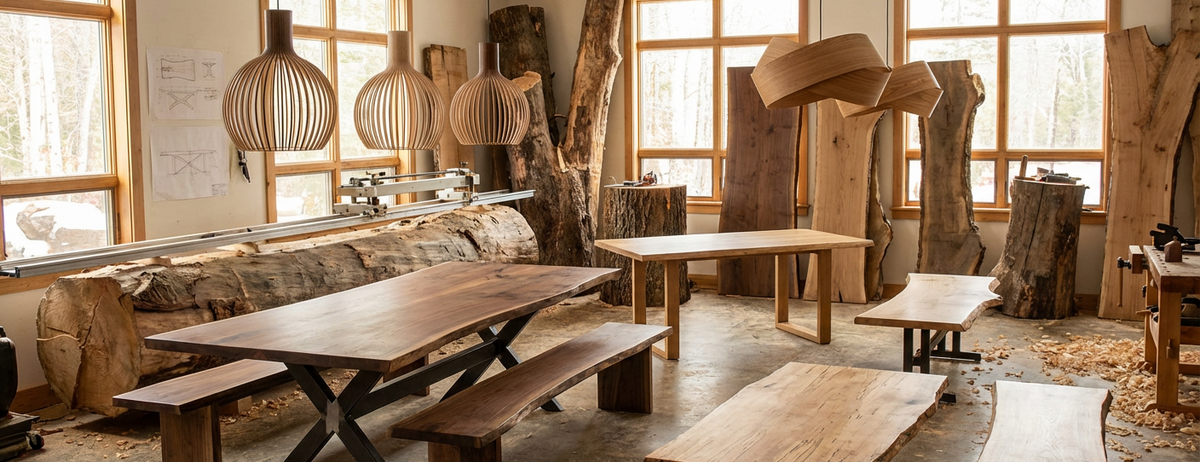
Live-edge Furniture – Contemporary Designs
Every piece in the Storyboard Furniture Ltd. collection begins with a single salvaged tree and ends as a one-of-a-kind statement. The live-edge is kept intact – preserving the natural contour of the trunk so no two pieces are ever alike.
Dining Tables
- Ebonised White Oak Dining Table – Hot-rolled steel Asterisk base. 120×40×30″
- Four Corners Dining Table – Eastbourne Norway Maple. 97×40×30″
- Black Walnut Dining Table – London suburb black walnut. Book-matched top with hot-rolled steel Asterisk base. 84×40×30″
- Alter Harvest Table – Castlefrank Road white oak. Book-matched and end-matched top with steel “sleeve” band. 168×46×30″
- Split Chevron Dining Table and Bench – Credit Heights black cherry. 95×40×30″
Coffee Tables
- Maple XXXY – Toronto spalted sugar maple from Cohen and Master Tree and Shrub Service. Hand-rubbed oil varnish finish, XXXY base. 63×17×19.5″
- Walnut Hairpin – Toronto walnut from Evencut Ltd. Tree Service. Hand-rubbed oil varnish finish, Hairpin base. 48×19×15″
- Chatham Walnut – From Al and Maryann Roberts. Hand-rubbed oil varnish finish, Lovers Quarrel base. 48×20×18″
Benches
- Lean in to Love – Junction black locust from Janet of LEAF. Raw oil finish, Square On base. Built for outdoors – black locust is naturally rot-resistant without chemical treatment. For those not ready to commit to a full live-edge dining table, a smaller bench like this one from Storyboard is a great way to try out this kind of furniture and see how salvaged wood fits into a home.
- Split Branch Bench – Huttonville apple from Big’r Apple Farm. Osmo Polyx Oil finish, Framed base. 30×14×16″
- Nesting Benches – Heritage Road Norway maple. Scandinavian soap finish with powder-coated Nesting base. Designed to tuck one beneath the other.
Lighting
- The Plane Cloud Pendant Lamp
A decorative pendant lamp shaped by the geometric play of 12 identical curls of steam-bent wood – reminiscent of the shaving curls off a well-tuned plane.
The Plane Cloud launched at the Toronto Interior Design Show, where it was recognised as one of the top design finds by Sarah Richardson, BlogTO, Livewithculture.ca, and GalerieCO of Montréal. It was later featured in the Arts and Life section of The Globe and Mail.
The steam-bent strips are salvaged from Toronto’s urban forest. One side is finished with a traditional Scandinavian soap finish; the other is coloured with Liquitex Professional colour-fast spray paint, available in close to 100 colours. Production models include white spun-metal fittings, 8 feet of white wire, and a ceiling plate. ESA certified.
- Sharpe’s Hedra
This impressive lamp by Storyboard Furniture, named Sharpe’s Hedra, is created from 36 pieces of wood and 11 pieces of paper, forming a variation of a cuboctahedron. The sturdy wooden skeleton uses traditional joinery, contrasted by a delicately formed paper skin with leaf cutouts – the cutouts match the leaf shape of the species used. Custom designs are available at a premium.
The design community has taken notice: Hedra, a shadow-casting lamp with a die-cut shade, by Mike Sharpe was highlighted alongside other urban wood initiatives. This initiative, which the City of Toronto partnered with local makers, put a spotlight on what can be done when fallen city trees are treated as a resource rather than waste.
Made to order in a variety of local hardwood species. Cotton rag paper – acid-free and archival. White spun metal fittings, 6 feet of clear wire with switch. ESA certified.
From Tree to Table – The Process
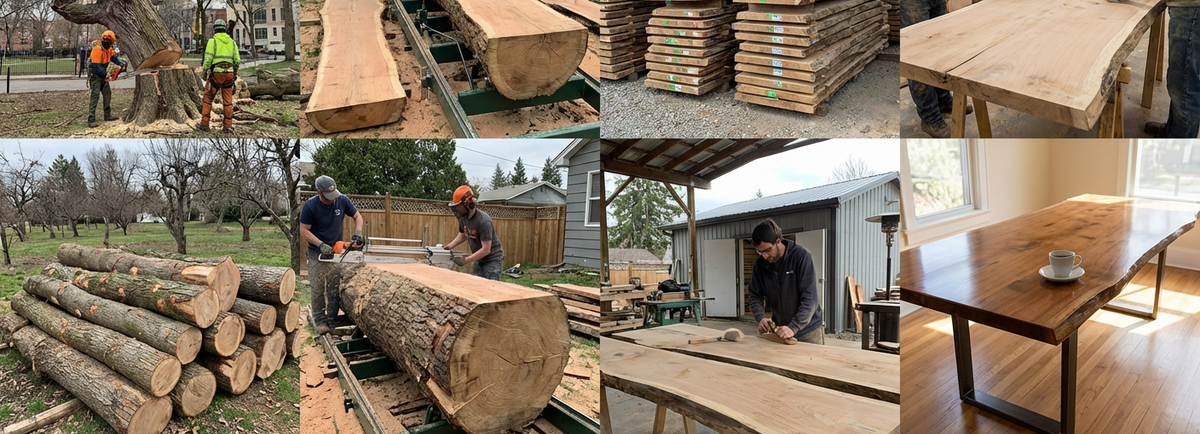
Storyboard Furniture Ltd. is often commissioned to build furniture from ill-fated trees. The team coordinates with certified arborists for safe removal. In other cases, the studio takes trunks from arborists and homeowners who would otherwise pay for trucking and disposal. In recent years, orchardists whose land is being developed have provided significant quantities of fruitwood.
- Milling. Trunks and limbs are milled into live-edge flitches (slabs). Where equipment access is good, a bandsaw mill or swingblade is used. In tight urban backyards – common across Toronto – a portable chainsaw mill handles trees up to 8 feet in diameter. The studio invested in a Logosol M8 bandsaw mill after its orchard salvage campaign, which noticeably improved cut quality and capacity.
- Drying. Thick stock is stickered and air-dried before entering the kiln. Air drying takes 3 to 24 months depending on thickness and species. Kiln drying brings moisture content down to 6-8% and takes up to 3 additional months. There are no shortcuts in this stage – proper drying prevents warping, cracking, and movement after the piece is built.
- Design. While the wood dries, the team works on design. Each piece is tailored to the character of the specific slab – its grain, figure, edges, and distinctive features. Steel bases are designed in-house, each with its own name: the Asterisk, the Hairpin, the Lovers Quarrel, the Nesting, the Framed, and others.
- Finishing. A slab is selected whose character complements the base design. City trees are notorious for their “flaws” – battle scars from life in the urban jungle. Storyboard highlights these to honour the tree and tell its story. The wood is flattened, sanded, and finished with the utmost care.
- Assembly. Base and slab come together. Just waiting for a morning coffee to join in.
Orchard Salvage – Kitchenware and Accessories
When a heritage orchard was slated for development, Storyboard Furniture launched an Indiegogo campaign to salvage as many trees as possible. The campaign raised nearly $20,000 – enough to harvest roughly 200 trees, purchase a Logosol M8 mill, and acquire an additional chainsaw.
From the salvaged apple wood, the studio produced kitchenware and accessories. But the most meaningful outcome was the community response – people sharing stories of how this orchard had touched their families across generations.
The project was made possible by a team of skilled craftspeople: Brian Volz, Andreas Merker, Scott Barber, Stephen Henderson, Joshua Brasse, Karen King, and Joerg Wittenbrinck. Thanks also to Kevin Chaves and Jack Alexander (campaign video), Tanya Neumeyer (open house), Lost Girl and Lukas Voz (fundraiser), and the Ferri and Potovszky families.
How to Care for Live-edge Furniture
Wood responds to humidity. In Canadian homes with forced-air heating, winter humidity can drop below 25%, causing minor surface checks. This is normal seasonal movement – most checks close again in spring.
- Keep humidity between 35-55%. A humidifier in winter is the single best preventive measure.
- Cleaning: Damp cloth. No harsh chemicals or silicone-based products. Mild dish soap for stubborn spills.
- Oil varnish finish: Very durable, no regular maintenance needed. A light sanding and fresh coat after several years if desired.
- Osmo Polyx Oil: Food-safe, easy to spot-repair. Thin coat on scratched areas, cure 24 hours, buff lightly.
- Scandinavian soap finish: Matte and natural. Periodic washing with pure soap (Marseille or dedicated wood soap). Avoid hot items directly on the surface.
- Outdoor pieces (raw oil): Wood silvers naturally over time. Reapply oil once or twice a year to maintain original colour.
- Heat and sunlight: Trivets under hot dishes. Cherry darkens with sun exposure; walnut lightens slightly. Both changes are natural.
Frequently Asked Questions
Commissioning furniture from a salvaged tree is not an everyday purchase, and most clients have questions before they begin. Storyboard Furniture Ltd. has answered these hundreds of times over the years – from homeowners watching a backyard maple come down to arborists looking for a better destination for quality trunks. Below are the questions that come up most often.
Can Storyboard Use a Tree From my Property?
Yes – this is the heart of the “Tree to Table” approach. If a tree is coming down, the studio can salvage the trunk and turn it into furniture, coordinating with the client’s arborist for safe removal.
How Long Does the Process Take?
Typically 6 to 27 months, mostly driven by drying time. If suitable kiln-dried stock is already on hand, timelines can be as short as 8-12 weeks.
What Species Does Storyboard Work With?
Whatever Toronto’s urban forest provides – black walnut, white oak, sugar maple, Norway maple, black cherry, apple, black locust, ash, and more.
Are the Lamps Safe?
All Storyboard Furniture lamps are ESA (Electrical Safety Authority) certified.
Can I Visit the Studio?
By appointment. The team is often out milling and on salvage jobs – call or email ahead.
Other Salvaged Wood Furniture Makers in Ontario
Storyboard Furniture is part of a growing community of Ontario makers who give salvaged and reclaimed wood a second life. Here are five other studios doing notable work in this space.
1. Urban Tree Salvage – Toronto
A husband-and-wife artisan team that has been turning discarded Toronto trees into custom furniture since 2004. Urban Tree Salvage is one of the longest-running operations of its kind in the city. The company handles all aspects of wood reclamation in-house – salvage, milling, drying, and manufacturing – and operates its own sawmills, dry kilns, woodshop, and metal shop on a multi-acre property. The product range is broad: live-edge and straight-cut dining tables, coffee tables, console tables, benches, countertops, shelving, and charcuterie boards. Corporate clients have included Aveda, Cineplex, Nike, Starbucks, and the University of Toronto.
Website: urbantreesalvage.ca
2. Cherrywood Studio – Schomberg (near Toronto)
Cherrywood Studio has been handcrafting contemporary hardwood tables from sustainably sourced Ontario wood since 2006. Designer and builder Steve Meschino sources, mills, and dries each piece himself, then uses both hand tools and precision machining to create the finished product. The studio’s focus is narrower than some competitors – primarily dining and office tables – but the depth of craft is evident. Clients hand-select their own slab before the build begins.
Website: cherrywoodstudio.ca
3. Na coille studio – Ottawa
A small team of craftspeople dedicated to creating custom, modern, clean-lined furniture from sustainably sourced, locally salvaged and reclaimed live-edge wood from the Ottawa area. The studio mills roughly 90% of its own wood, most of it sourced within a 45-minute drive of the shop. Species include black walnut, black cherry, hard maple, eastern hemlock, white oak, red oak, and American elm. Na coille also works with old-growth reclaimed lumber from derelict Ottawa Valley barns and buildings, some dating back over 200 years. They serve both residential and commercial clients in Ottawa and Toronto.
Website: nacoillestudio.com
4. Live-edge Forest – Muskoka
An award-winning artistic duo – Dan and Candice – who work exclusively with fallen trees and ancient timbers drawn from the depths of the Muskoka lakes. Their work leans more toward functional art than conventional furniture: live-edge river tables, epoxy-and-wood pieces, and their signature wood-and-stone wall art incorporating stones collected on cross-Canada travels. All wood is sustainably sourced from fallen or downed trees and kiln-dried on-site. A strong option for clients looking for something more sculptural.
Website: liveedgeforest.com
5. The Kopper Mill – Ajax
The Kopper Mill creates solid wood furniture from locally salvaged Ontario hardwoods, along with epoxy river tables and custom steel bases. Beyond finished furniture, the studio also supplies live-edge slabs, finishing oils, sandpaper, and adhesives for the DIY community – making it a resource for both buyers and fellow makers. The founder has over a decade of experience working with epoxy resin, and the studio offers private consultations for custom projects.
Website: thekoppermill.ca